

S:DISS-X Basic Practical Program
Class 6
“Inquiry With Purpose”
 Basic Practical Class Index (Click to Access)
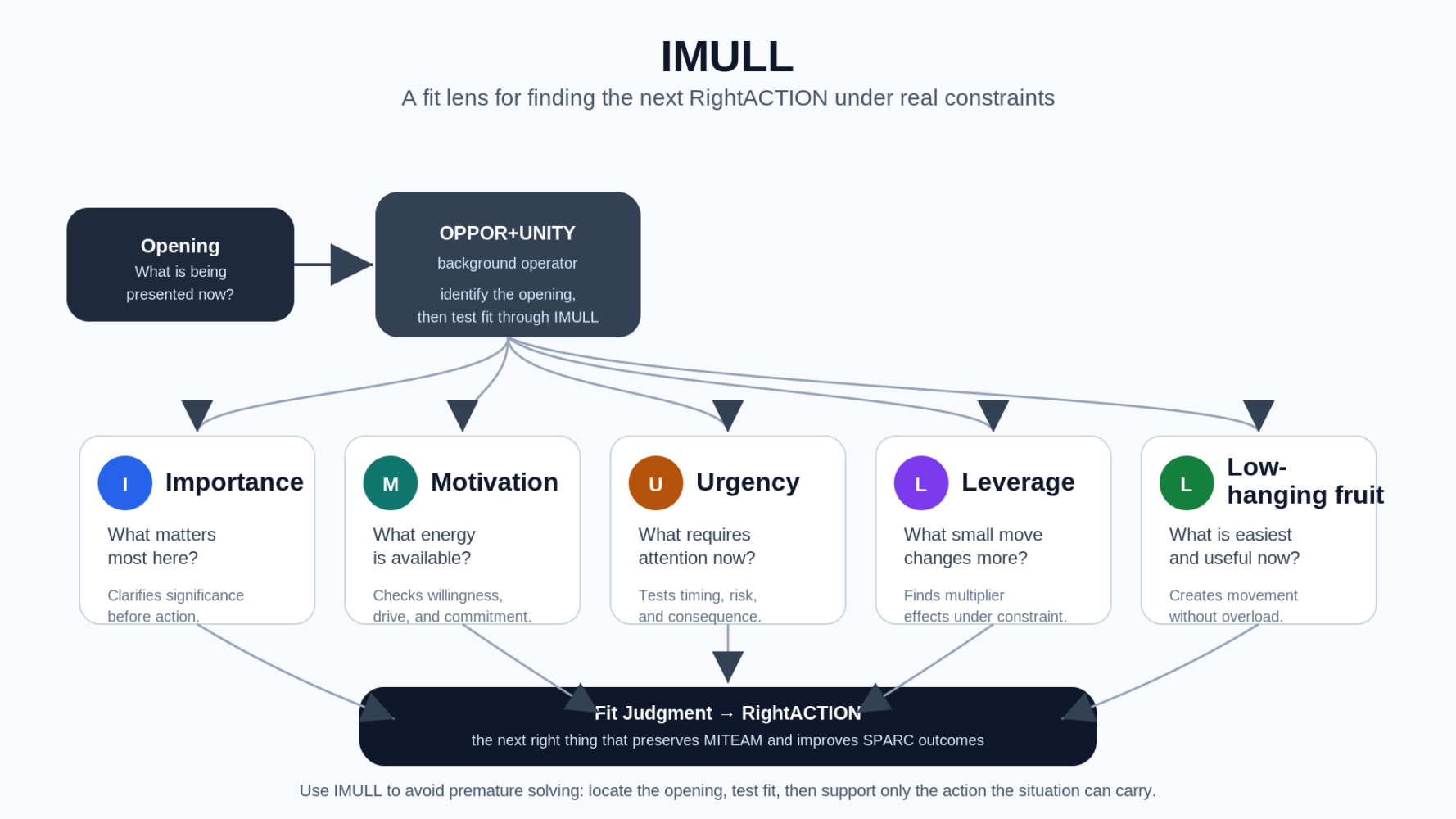
IMULL Visual Diagram (Click to Access)
First Principles (Click to Access)
Class 5 is useful, but it again confirms the main tension in the Basic Practical series:
The material is basic. The commentary is not.
That is not a failure. It gives us the clearest advice for Class 6: separate basic practice from founder commentary / advanced notes more visibly.
The strongest Class 5 teaching line is already present:
Let the person being helped show what they can carry before you add help.
That should probably become the Class 5 title or study-guide anchor.
What worked
Class 5 does a good job reinforcing that S:DISS-X exists to meet people where they are, that purpose is already present, and that self-organizing beats control. It also clarifies that if the helper leads too much, the scaffolding is built from the helper’s capability rather than the PBH’s capability.
The class also gives a very good real-time correction of the AI exchange around “ideas?”. The assistant treated “ideas?” as a request for planning and generated options. Your correction was right: in the basic exchange, “ideas?” had not been tabled, so it was a PING, not a PROBE. The cleaner move would have been to stay with “Ideas?” first instead of generating three options.
The “good place to pause?” moment is also valuable. The AI should have simply answered “Yes.” Instead, it explained the lesson again. That shows the exact over-helping pattern you are trying to teach students to notice.
What needs correction or tightening
First, the First Principles section is valuable, but it is too much for the basic class body. It should become a reference page, handout, or “advanced note.” In the live class, use one sentence: “These examples sit on first principles, but today we are practicing one small move.”
Second, Class 5 should not try to teach first principles, pCc, generator/protector/moderator, ARIA(H), SPARC, and the live exchange all in one flow. Those are important, but the learner’s attention gets split.
Third, the phrase “I think I see it now” is a good teaching object. Your critique is important: “See it?” is not necessarily the most leveraged cue. Other possible openings include “I?” “Think?” “It?” “Now?” This is a strong Basic-to-Intermediate bridge because it teaches that exact-word cueing is not mechanical parroting. It is selective.
Recommended Class 6 focus
I would make Class 6 about one thing:
Do not let a cue become an invitation to over-help.
Student-facing title:
Class 6: One Cue Is Not a Request to Take Over
Basic example:
PBH: I need ideas.
Helper: Ideas?
PBH: Yes. Maybe I’m asking too soon.
Helper: Too soon?
PBH: I think I need to know what matters first.
Helper: What’s important?
Forms used:
PING: “Ideas?” because ideas had not yet been tabled as a working context.
PROBE: “Too soon?” because the PBH tabled the phrase.
PING / IMULL reset: “What’s important?” because importance becomes the next useful test.
Basic TPOVs:
Do not over-help.
Do not generate options too soon.
A request for ideas may still need problem finding.
Use the PBH’s words selectively.
Return to IMULL when the next move is unclear.
My overall advice
Class 5 has very strong source value. For teaching, it needs a cleaner separation:
Basic class: one example, one cue, one correction, one lesson.
Study guide: concepts, models, first principles, and AAR.
Advanced note: founder commentary, AI learning, ego position, G-P-M, and deeper canon.
The class should end with this simple rule:
When the PBH gives you a word, do not assume it asks for your capability. First test whether the word itself is the opening.

Join us,
Our team at Living & Loving Inquiry
Mike R Jay & Gary Gile
Founders @ The NEW LeadU
Subscribe @ leadu.com/news
PS: For clarification –
- If you just want notice of the LeadU blog posts subscribe @ leadu.blog
- If you want the blog content by email, our weekly newsletter, and breaking news, subscribe @ leadu.com/news.
- Disclaimer
Notice: To pre-order a copy of Mike’s latest book mentioned in some of his posts in e-book format for $9.97 (available late 2026), visit HERE to be first in line.
If you have any comments, questions, suggestions, or need some additional help, please visit https://www.leadu.com/comment/ to submit them. Someone will get back to you within 48 hours.
We hope you pick up valuable insights, ideas, and tools during this process, which you can use for your own development as well as your work and leadership with others.
You, Me, and We @LeadU
 Mike R. Jay is a developmentalist utilizing consulting, coaching, advising and helping… emergent from dynamic inquiry as a means to cue, scaffold, support, lift, and protect; offering inspiration to aspiring leaders who are interested in humaning where being, doing, having, becoming, contributing, relating, guiding to produce resilience and wellth help people lead generative lives.
