S:DISS-X Basic Practical Program
Class 7
“Returning to the Basics”
 Basic Practical Class Index (Click to Access)
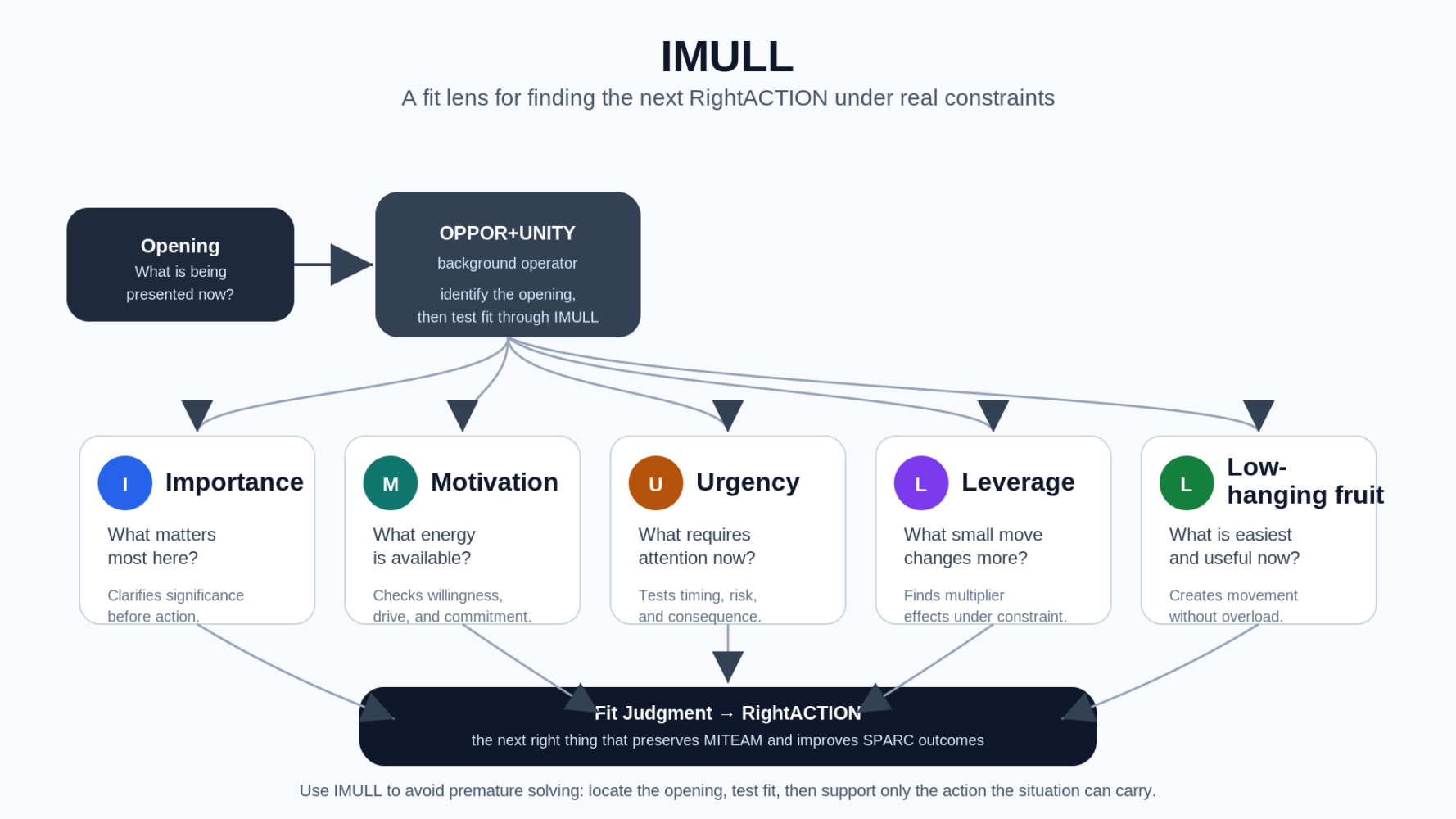
IMULL Visual Diagram (Click to Access)
First Principles (Click to Access)
GPM (Click to Access)
Yes. Class 6 is probably the cleanest canon-correction class so far. It names the recurring issue directly:
The material is basic. The commentary is not.
That is not a failure. It gives you the strongest setup for Class 7: separate the basic move, the AAR, the founder commentary, and the advanced notes more visibly.
The main Class 6 teaching line should become:
A cue is not a request to take over.
That is stronger than “do not over-help” because it is more concrete. In the exchange around ideas, the key correction is that a helper should not automatically generate ideas just because the PBH says “ideas.” The word may be an opening, a request, a deflection, or the helper’s temptation to start producing.
My main ideas:
Make Class 7 the wrap-up around three rules.
The series now has enough material. Class 7 should not introduce much new theory. Use it to land the basics:
Rule one: Use the PBH’s words selectively, not mechanically.
Rule two: Do not let a cue become an invitation to over-help.
Rule three: Return to IMULL when the next move is unclear.
Correct the “ideas” teaching carefully.
If the PBH says “I need ideas,” then “Ideas?” is not a PING. It is a PROBE because “ideas” has already been tabled. It would only be a PING if “ideas” had not appeared yet. This is a good basic example because it teaches that form is context-dependent, not word-dependent.
Use “need?” as the cleaner basic cue.
Your correction is strong: in “I need ideas,” the more leveraged word may be “need?”, not “ideas?” “Ideas” is the object. “Need” points closer to purpose, importance, motivation, and the problem-finding system.
Add the “no two mirrors without IMULL” rule.
This is a practical Basic rule:
Do not use two exact-word mirrors/wonders in a row unless IMULL is already present.
Otherwise, it becomes robotic, tactical, and helper-centered. After one selective cue, return to the map: What’s important? Is there motivation? Is this urgent? Is there leverage? Is there one small place to begin?
Clarify WI again.
What’s important? is not always a PING. If importance has not been tabled, it can function as a PING or IMULL reset. If the PBH has already said something like “I need to know what matters first,” then “What’s important?” is closer to PROBE or PERMIT because the territory has already been tabled.
Preserve the AI-learning distinction.
The line “I can register, preserve, and apply a correction, but I do not human the learning” is important. It belongs in HAICU/APC source material. It protects the difference between AI pattern adaptation and human lived developmental change.
One admin correction: in the transcript, GPM/GPN gets fuzzy. For current canon, keep GPM / G-M-P = Generator, Protector, Moderator. Do not let that collapse into “generative metaparadigmatic” language unless you intentionally create a separate acronym.
For Class 7, I would use this title:
Class 7: The Basic Rule — Let Them Show What They Can Carry
And this closing frame:
Basic S:DISS-X is not about asking better questions. It is about restraining the helper long enough for the PBH’s own problem-finding and problem-solving system to appear.
That closes the seven-class arc cleanly.

Join us,
Our team at Living & Loving Inquiry
Mike R Jay & Gary Gile
Founders @ The NEW LeadU
Subscribe @ leadu.com/news
PS: For clarification –
Notice: To pre-order a copy of Mike’s latest book mentioned in some of his posts in e-book format for $9.97 (available late 2026), visit HERE to be first in line.
If you have any comments, questions, suggestions, or need some additional help, please visit https://www.leadu.com/comment/ to submit them. Someone will get back to you within 48 hours.
We hope you pick up valuable insights, ideas, and tools during this process, which you can use for your own development as well as your work and leadership with others.
You, Me, and We @LeadU
 Mike R. Jay is a developmentalist utilizing consulting, coaching, advising and helping… emergent from dynamic inquiry as a means to cue, scaffold, support, lift, and protect; offering inspiration to aspiring leaders who are interested in humaning where being, doing, having, becoming, contributing, relating, guiding to produce resilience and wellth help people lead generative lives.