

S:DISS-X Basic Practical Program
Summary
“ Make Restraint Visible”
Class 7
 Basic Practical Class Index (Click to Access)
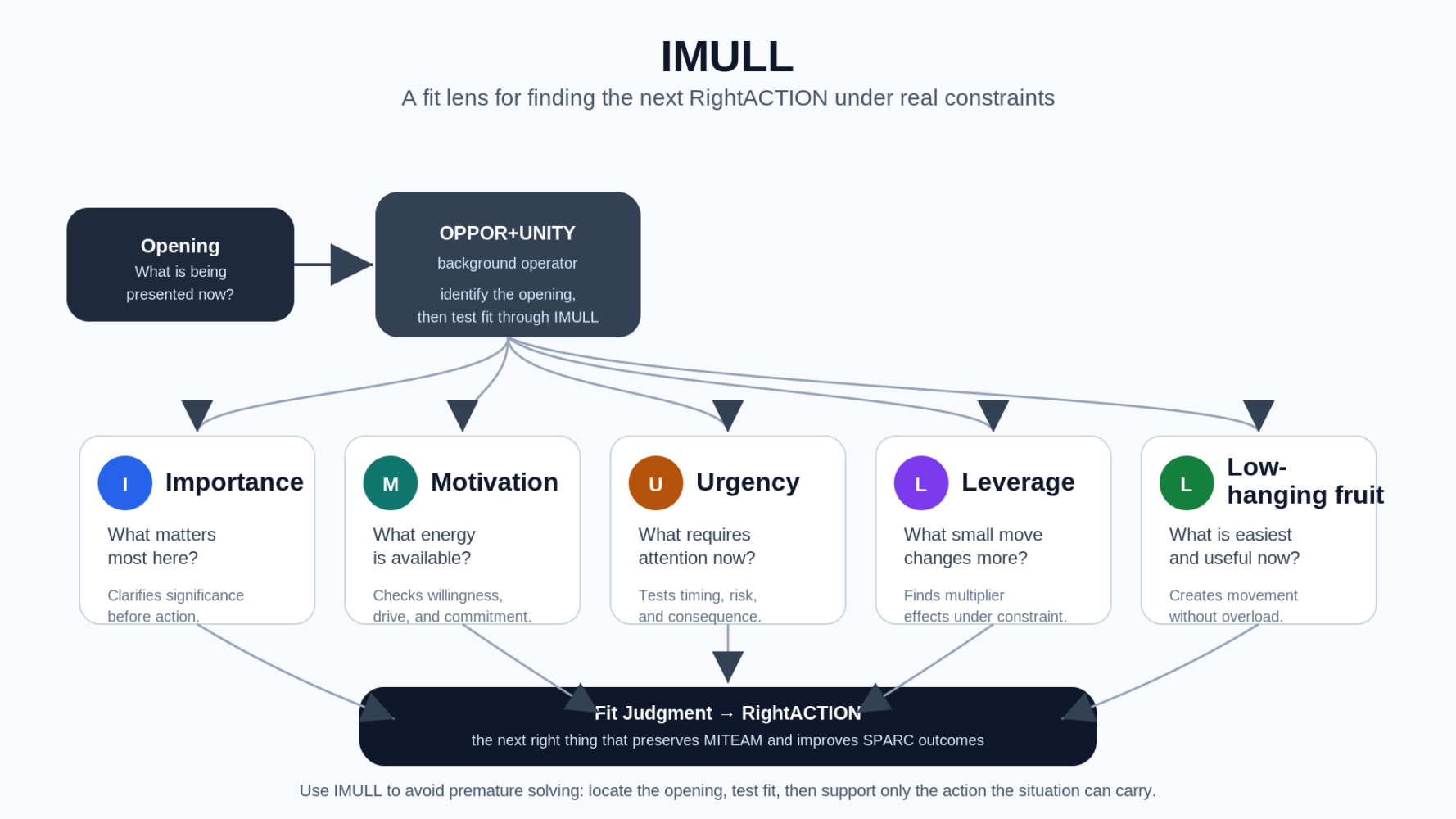
IMULL Visual Diagram (Click to Access)
First Principles (Click to Access)
GPM (Click to Access)
Helping is not the same as solving.
That is where we began, and that is where we should end.
Across these basic practical classes, we have been learning how to slow helping down enough to notice what is actually happening.
Not forever.
Not to avoid action.
Not to make the process complicated.
Just long enough to avoid taking over.
The basic work has been framed around three learning moves:
See the move.
Recognize the pattern.
Let the fitting form appear under simple conditions.
At the basic level, S:DISS-X is not about using clever questions.
It is not about asking more questions.
It is not about repeating every word the person says.
It is not about sounding like a coach, consultant, teacher, manager, or expert.
It is about meeting the person where they are.
And the only way we can do that is to let the person being helped show us where they are.
That is why restraint matters.
If the helper moves too fast, the helper’s capability enters the space too soon.
If the helper interprets too soon, the helper’s meaning replaces the person’s meaning.
If the helper gives advice too soon, the helper may solve the wrong problem.
So the basic rule is simple:
Let the person being helped show what they can carry before you add help.
That one rule protects much of the system.
It protects pCc.
It protects RWAF.
It protects IMULL.
It protects MITEAM.
It protects RightACTION.
And it protects the person being helped from being moved faster than their system can actually carry.
In this basic series, we practiced three simple rules.
First, use the person’s words selectively, not mechanically.
A word from the person may carry an opening.
But that does not mean we repeat every word.
We listen for the word that may carry importance, motivation, urgency, leverage, or low-hanging fruit.
Second, do not let a cue become an invitation to take over.
If someone says, “I need ideas,” the helper may be tempted to start generating ideas.
But the better move may be to stay with the need.
“Need?”
Or to return to the map.
“What’s important?”
The person may not be asking for ideas yet.
They may still be finding the problem.
Third, return to IMULL when the next move is unclear.
Importance.
Motivation.
Urgency.
Leverage.
Low-hanging fruit.
IMULL is the basic map.
When we do not know where to go next, we do not need to panic.
We return to the map.
Is this important?
Is there motivation?
Is there urgency?
Is there leverage?
Is there one small place to begin?
This helps us avoid forcing the conversation from our own frame.
It helps the person’s own problem-finding and problem-solving system appear.
That is the deeper purpose of basic S:DISS-X.
Not better questions.
Better restraint.
Not more technique.
Better fit.
Not helping as much as we can.
Helping only as much as the moment calls for.
Sometimes the right move is a word.
Sometimes it is a pause.
Sometimes it is a simple cue.
Sometimes it is giving the person the milk.
Sometimes it is not entering inquiry at all.
That is why the “S” matters.
S:DISS-X is selective.
We use the forms when they fit.
PING.
PROBE.
PROMPT.
PERMIT.
PERTURB.
PAUSE & Breathe.
PACE.
These are forms of inquiry.
They are not scripts.
They are not seven steps.
And they are not the same as skills.
Skills develop as we practice the forms.
The basic practice now is simple:
Pause before adding capability.
Listen for the opening.
Use the map.
Let the person show what they can carry.
Then support RightACTION when it is ready.
That is the low-hanging fruit.
Make restraint visible.
If you practice nothing else from this basic series, practice that.
Pause before adding your capability.
Because when the helper can restrain their own need to help, the person being helped has a better chance to appear.
And once the person appears, the real helping can begin.

Join us,
Our team at Living & Loving Inquiry
Mike R Jay & Gary Gile
Founders @ The NEW LeadU
Subscribe @ leadu.com/news
PS: For clarification –
- If you just want notice of the LeadU blog posts subscribe @ leadu.blog
- If you want the blog content by email, our weekly newsletter, and breaking news, subscribe @ leadu.com/news.
- Disclaimer
Notice: To pre-order a copy of Mike’s latest book mentioned in some of his posts in e-book format for $9.97 (available late 2026), visit HERE to be first in line.
If you have any comments, questions, suggestions, or need some additional help, please visit https://www.leadu.com/comment/ to submit them. Someone will get back to you within 48 hours.
We hope you pick up valuable insights, ideas, and tools during this process, which you can use for your own development as well as your work and leadership with others.
You, Me, and We @LeadU
 Mike R. Jay is a developmentalist utilizing consulting, coaching, advising and helping… emergent from dynamic inquiry as a means to cue, scaffold, support, lift, and protect; offering inspiration to aspiring leaders who are interested in humaning where being, doing, having, becoming, contributing, relating, guiding to produce resilience and wellth help people lead generative lives.
